

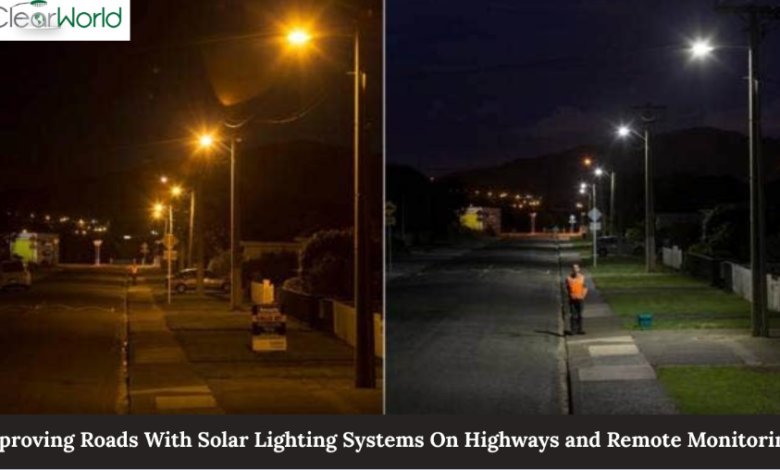
Every year, poorly lit highways claim lives that better infrastructure could have protected. Drivers lose reaction time in the dark, emergency crews navigate accident scenes without adequate visibility, and maintenance teams drive entire corridors just to find a single failed light. Solar Lighting Systems On Highways and Remote Monitoring addresses each of these problems with one connected solution, off-grid illumination that sustains itself and reports its own health in real time. This blog walks through how the technology works, what it genuinely delivers for highway safety, and where deployment teams should tread carefully.
How Does a Solar Lighting System for Highways Remote Monitoring Actually Work?
Before transportation agencies commit budgets to large-scale deployment, they need a working understanding of what these systems do at the pole level and across the network as a whole. Solar Lighting Systems On Highways and Remote Monitoring builds each pole as an independent, self-reporting unit while connecting every unit to a single management platform.
Solar Energy Collection
Each pole carries solar panels that collect and convert sunlight throughout the day. Well-engineered configurations keep generating usable energy even when clouds roll in, so battery reserves across a corridor stay stable through weather patterns that would leave a poorly specified system struggling by midnight.
Battery Storage Management
Lithium-ion batteries onboard each pole store collected energy and control how it discharges across the night. Intelligent management circuitry prevents both overcharging and deep discharge, the two failure patterns that shorten battery life fastest in outdoor infrastructure exposed to temperature swings and heavy seasonal variation.
LED Lighting Output
Highway-grade LED fixtures deliver high-lumen output while drawing a fraction of the energy that older sodium or metal halide lamps consume. They hold consistent performance through cold winters and hot summers alike, which matters on highway corridors where ambient conditions test equipment year-round without relief.
Adaptive Dimming Controls
The remote monitoring platform gives operators direct control over dimming schedules. Traffic volume, time of night, and motion detection inputs all feed into how the system manages brightness. When a vehicle or pedestrian enters a zone, full output activates immediately. During quiet stretches, the system scales back and conserves the battery reserves that keep it running until dawn.
Fault Detection and Alerts
Every pole in a Solar Lighting Systems On Highways and Remote Monitoring network streams operational data continuously. When a battery drops below a set threshold, a panel underperforms, or a fixture stops responding, the platform flags the fault and identifies the exact location. Maintenance teams receive that information before anyone drives a single kilometre of inspection.
System-Wide Reporting
A centralised dashboard brings together performance data from every pole across the corridor. Operations teams use it to read energy trends, schedule service visits with precision, and produce the performance documentation that compliance and reporting cycles demand.
Agencies that run these systems long enough come to see remote monitoring not as a feature but as the operating model that makes large-scale highway lighting manageable without proportional growth in maintenance staff.
What Benefits Does Solar Lighting System Remote Monitoring Deliver?
Transportation departments that put Solar Lighting Systems On Highways and Remote Monitoring infrastructure into service find that the improvements show up across safety outcomes, maintenance budgets, and long-term operational costs simultaneously.
Consistent Illumination
Grid outages, storm damage, and utility failures do not darken a solar highway. The system carries its own stored energy and keeps roads lit through exactly the conditions under which road accidents and emergency callouts tend to spike.
Lower Maintenance Expenditure
Inspection drives along highway corridors burn labour hours and put maintenance personnel in proximity to fast-moving traffic. Remote fault detection replaces broad patrol runs with targeted callouts. Crews travel to a specific pole with a specific problem, not along an entire corridor, hoping to spot something wrong.
Stronger Emergency Response
First responders working accident scenes after dark need reliable ambient lighting to function safely and efficiently. Solar Lighting Systems On Highways and Remote Monitoring keep that lighting active through the grid failures and severe weather events that cause the emergencies demanding a response in the first place.
Full Grid Independence
Remote highway sections often sit beyond what utility grid infrastructure can serve cost-effectively. Solar lighting systems reach these corridors without trenching, without grid connection costs, and without inheriting the vulnerability to utility outages that grid-tied systems carry permanently.
Network Scalability
One monitoring platform handles everything from a single interchange installation to a corridor running hundreds of kilometres. As agencies expand their solar highway networks over time, the monitoring infrastructure grows with them without requiring a rebuild at each phase.
The combination of consistent safety performance, reduced operational burden, and long-term cost discipline makes remotely monitored solar highway lighting a decision that holds up financially and operationally well into the second decade of service.
What Constraints Do Solar Lighting Systems On Highways and Remote Monitoring Projects Face?
Honest deployment planning accounts for where this technology runs into difficulty. The agencies that navigate these constraints well do so because they address them during specification, not after installation.
Limited Solar Irradiance Zones
Highway corridors at higher latitudes or through regions with prolonged seasonal overcast conditions generate less solar energy than installations in sunnier climates. Engineers must size battery storage and panel capacity against actual irradiance data for each specific site. A specification built on regional averages produces systems that run short on power precisely when winter nights are longest, and demand is highest.
Upfront Cost Pressure
Solar poles with integrated battery systems and remote monitoring carry a higher initial unit cost than conventional grid-tied streetlights. Agencies that assess the total cost of ownership across 25 years consistently find the economics favour solar. The friction point is annual budget cycles, where capital expenditure ceilings take priority over lifecycle analysis. Phased deployment gives agencies a practical path through that constraint without abandoning the long-term case.
Wireless Coverage Gaps
Remote monitoring depends on reliable wireless data transmission from each pole back to the central platform. Corridors passing through areas with thin cellular infrastructure develop monitoring blind spots that reduce fault detection reliability exactly where physical inspection is hardest to conduct. Pre-deployment site surveys must map wireless coverage across the full corridor, and agencies working in low-coverage regions need to factor connectivity infrastructure into project scope before the first pole goes in the ground.
Conclusion
Solar Lighting Systems On Highways and Remote Monitoring gives transportation agencies the kind of infrastructure that grid-tied lighting has never been able to provide. Highway lighting that sustains itself, communicates its own condition, and keeps roads safe through the failures and disruptions that traditional systems succumb to. Agencies that go into deployment with a clear understanding of both the technology’s strengths and its real constraints build highway lighting networks that serve road safety dependably for decades ahead.